
Crypto Risk Management Signals: Capital Preservation First
Yaga Calls provides risk-aware Telegram crypto signal notes built around market context, entry zones, target planning, invalidation logic, and disciplined setup review.
A signal is not serious if it only talks about upside. It must also explain risk.
Educational market analysis only. Crypto trading involves risk. No signal provider can guarantee profit.
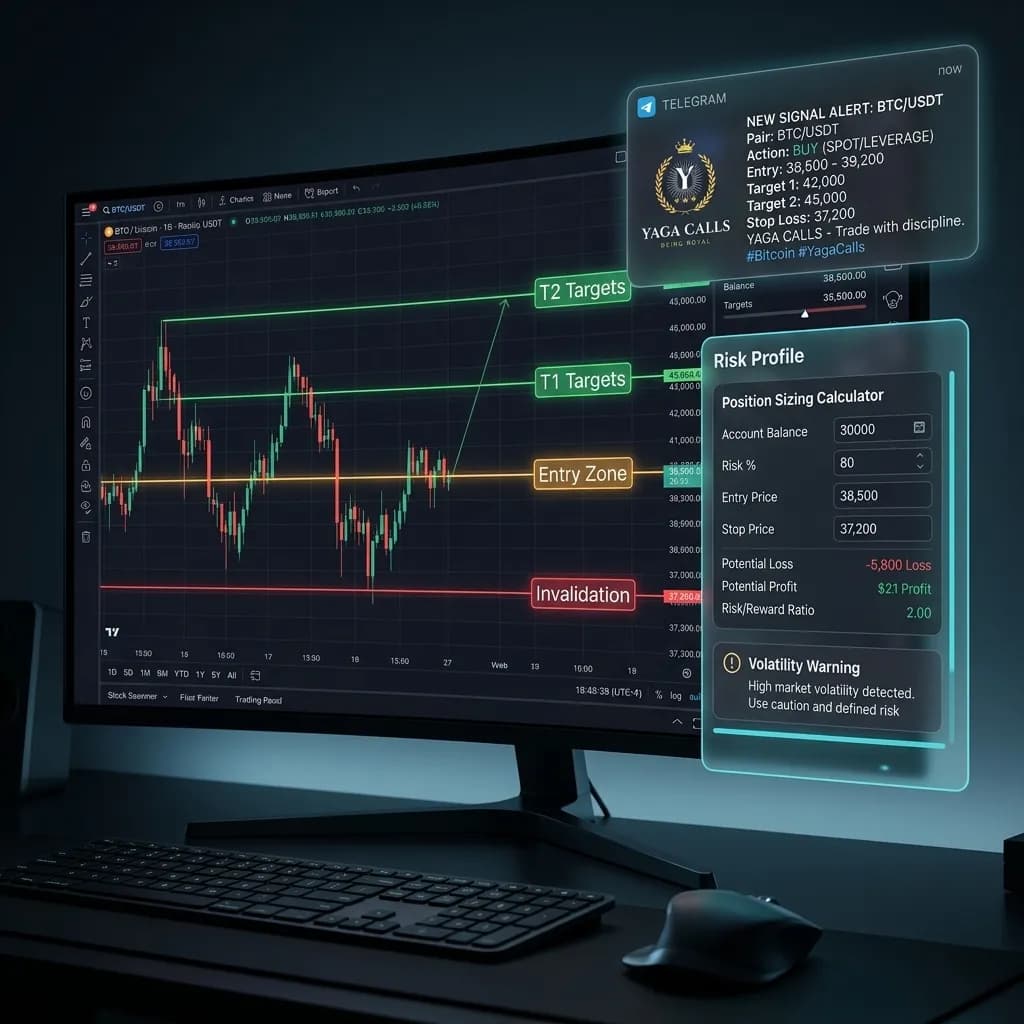
What Are Crypto Signals With Risk Management?
Crypto signals with risk management are trading setup notes that include more than a coin name and a direction. A risk-managed signal should explain the entry zone, target levels, invalidation point, stop-loss context, market reason, and risk considerations before a trader acts.
Yaga Calls focuses on this type of signal structure. The goal is to help traders evaluate setup ideas with more discipline instead of reacting to random pump alerts.
"Yaga Calls provides crypto signals with risk management by combining market narrative research, technical setup validation, entry zones, target planning, invalidation logic, stop-loss context, and Telegram-based signal delivery. The service is designed for serious traders who want structured market context instead of random pump calls or guaranteed-profit claims."
Why Risk Management Matters
Crypto markets are volatile. Even strong setups can fail. Risk management helps traders answer the most important question: "What happens if I am wrong?"
The Survivor's Rule
The first goal is not to win every trade. The first goal is to avoid letting one bad trade damage the whole account.
Strategic Questions
- • Where does the idea become wrong?
- • How much capital is at risk?
- • Is the entry zone still valid?
The Anatomy of a Risk-Managed Signal
A crypto signal without risk context is not a complete setup. Yaga Calls includes these core elements in every premium signal note.
Asset / Pair
Clear identification of the asset and trading pair.
Market Reason
The narrative, catalyst, or technical reason behind the setup.
Entry Zone
Where the setup makes sense, avoiding 'buy now' FOMO.
Target Levels
Reaction zones for profit-taking or setup reassessment.
Invalidation
Where the original thesis is no longer valid.
Risk Note
Context on position sizing and market volatility.
Entry, Target, and Invalidation
These three markers form the skeleton of any serious signal. Entry shows where the trade starts. Targets show where it may be reviewed. Invalidation shows where discipline matters.
Entry Zone: Prevents chasing aggressive moves after the opportunity has passed.
Target Areas: Defined levels for partial profit-taking to secure gains.
Invalidation Point: The "exit door" where the trading idea is objectively wrong.
Narrative: Ecosystem Growth + Key Support Retest
Entry Zone
142.50 - 144.20
Invalidation
138.80
Targets
152.00 / 165.00 / 180.00+
Note: High volatility expected around news release. Position size: 1%
Stop Loss vs Invalidation
Many traders use these terms interchangeably, but they serve different roles in a disciplined trading plan.
Invalidation
The thesis failure point. Where the setup logic no longer holds true based on market structure.
Stop Loss
The execution tool. A specific level used to limit downside and control risk per trade.
Position Sizing & Survival
The biggest mistake many traders make is risking too much on one idea. Even if a signal looks strong, position sizing is what allows you to stay in the game.
The 1–2% Principle
"A good setup can still become a bad trade if the position size is wrong. Yaga Calls recommends a disciplined framework where no single setup controls the account's survival."
Risk-Managed Signals vs Pump Calls
A provider that ignores downside is asking traders to trust excitement. A provider that explains risk gives traders a framework.
| Factor | Pump-Style Signal Group | Yaga Calls Standard |
|---|---|---|
| Main message | “Buy now” | Setup context first |
| Entry | Often vague | Entry zone explained |
| Invalidation | Missing | Clearly identified |
| Stop loss | Ignored | Discussed clearly |
| Claims | Guaranteed profit | Risk-aware language |
Who This Is For
- Serious traders who want structure
- Investors tired of Telegram noise
- Users who value entries and targets
- Those who understand losses happen
- People ready to observe before buying
Who This Is Not For
- People looking for guaranteed profit
- Users wanting no-loss trading
- Seekers of cheap 'lifetime' VIPs
- Random pump call hunters
- Emotional 'all-in' traders
Yaga Calls is not built for users looking for guaranteed monthly profit. It is built for serious traders who want risk-aware market context.
Start With Risk Management First.
The best way to evaluate Yaga Calls is to join the free Telegram group first. Observe the market notes, selected examples, and risk-aware language before deciding on premium.
Past performance does not guarantee future results. Crypto trading involves risk. Yaga Calls provides educational market analysis and signal ideas only.
Related Strategic Research & Resources
Frequently Asked Questions
What are crypto signals with risk management?
Crypto signals with risk management are trading setup notes that include market context, entry zones, target levels, invalidation or stop-loss context, and risk awareness instead of only naming a coin to buy.
Does Yaga Calls provide crypto signals with stop-loss context?
Yaga Calls focuses on risk-aware signal notes, invalidation logic, stop-loss context, and position sizing awareness. Crypto trading still involves risk, and no signal provider can guarantee profit.
What is invalidation in a crypto signal?
Invalidation is the condition or price area where the original setup idea becomes wrong or needs reassessment. It helps traders avoid holding emotionally when the trade thesis fails.
Why is risk management important in crypto signals?
Risk management is important because crypto markets are volatile and even strong setups can fail. Risk context helps traders understand downside, position sizing, stop-loss thinking, and when to reassess a setup.
Are crypto signals safe if they include stop loss?
No crypto signal is completely safe. Stop-loss and invalidation context can help manage risk, but they do not remove market volatility, slippage, execution risk, or personal responsibility.
What should a good crypto signal include?
A good crypto signal should include the asset, market reason, entry zone, target levels, invalidation or stop-loss context, risk awareness, and follow-up logic when market conditions change.
Does risk management guarantee profit?
No. Risk management does not guarantee profit. It helps traders control downside and make more disciplined decisions, but crypto trading always involves risk.
Is Yaga Calls a pump group?
No. Yaga Calls is positioned as a research-led crypto signal and market analysis provider focused on structure, narratives, entry zones, invalidation, and risk-aware Telegram delivery.
Can beginners use risk-managed crypto signals?
Beginners can learn from risk-managed signal notes, but they should first understand basic crypto volatility, stop-loss logic, position sizing, and personal risk responsibility before considering premium access.
How can I evaluate Yaga Calls before premium?
You can join the free Telegram group, read the Yaga Calls method page, review selected proof examples, and compare premium plans only if the structure fits your trading approach.