
Stablecoin Remittances vs. Western Union: How Sending Money in USDT Saves 84% on Fees
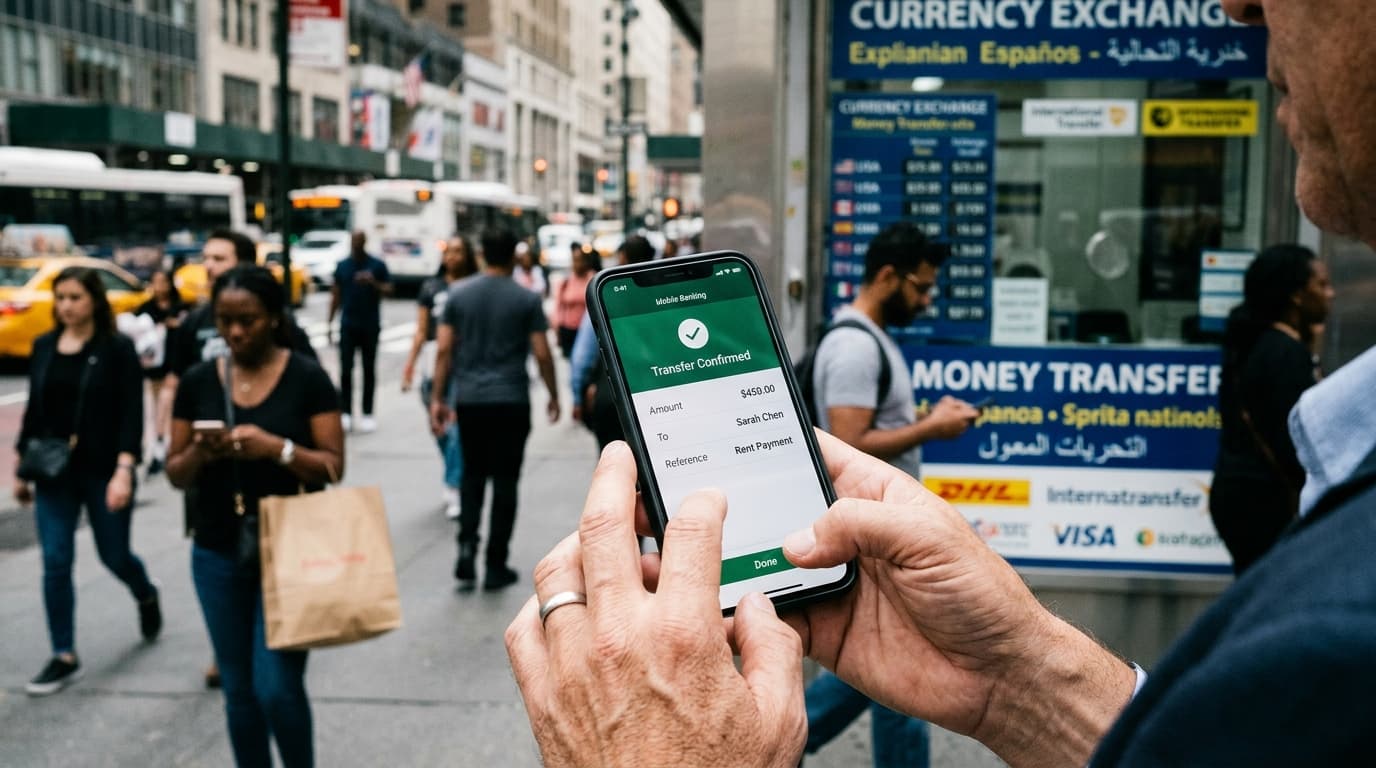
Photo Dispatch: Documentary editorial street photography of hands holding a smartphone confirming an instant digital payment transfer with a money transfer storefront in the backgroundSource: Yaga Newsroom Field Wire
“How much can you save sending money home with stablecoins? We compare Western Union and SWIFT wire fees against Base and Solana USDT transfers, auditing the 84% savings and capital growth math.”
Sending cross-border remittances with stablecoins like USDT or USDC costs up to 84% less than traditional money transfer operators like Western Union, settling in under 5 seconds for less than $0.05 in network fees.
Table of Contents
Stablecoin Remittances vs. Western Union: How Sending Money in USDT Saves 84% on Fees
Sending cross-border remittances using USD-pegged stablecoins (such as USDT or USDC) costs up to 84% less than traditional money transfer operators like Western Union or retail banking SWIFT wires. According to verified benchmarks published by the World Bank Remittance Prices Worldwide Database , the global average cost to send a $500 cross-border transfer through legacy cash agents is 6.25% ($31.25 USD), with delivery taking 1 to 3 business days. By routing through modern Layer-1 and Layer-2 blockchains (such as Base, Solana, or Tron), the identical transfer completes in under 5 seconds for less than $0.05 USD in network gas fees.
$28 – $45 USD
Fee + 2.5% FX Spread Markup< $0.05 USD
Direct on Solana / Base network2.4 Seconds
Instant finality 24/7/36584% to 92%
Kept in your family's pocketsThe Hidden 3-Tier Fee Structure of Legacy Money Transfers
When an expat, foreign worker, or digital freelancer sends money home through traditional financial institutions, the advertised transfer fee is only the visible tip of an exploitative fee pyramid:
Upfront Retail Cash Surcharges
Legacy brick-and-mortar storefronts charge fixed or percentage-based wire fees ranging from $8 to $18 per transaction, irrespective of whether the transfer is sent to South Asia, Sub-Saharan Africa, or Latin America.
The Predatory FX Spread Markup
The largest hidden fee is the foreign exchange spread. As documented in Western Union's SEC Form 10-K filings, operators mark up the interbank exchange rate by 2.0% to 4.5%, silently skimming $15 to $25 from every $500 sent.
Correspondent SWIFT Intermediaries
Bank wire transfers route through 2 to 4 intermediary clearing banks. Each correspondent bank deducts a $10–$25 handling fee, leaving the recipient with far less than what was originally deposited.
How Stablecoins Eliminate the Middleman: The Circle & Tether Rails
Stablecoins are not volatile speculative meme tokens; they are tokenized US dollars backed 1:1 by liquid cash reserves and short-term US Treasury bills. As confirmed by Circle Internet Financial CEO Jeremy Allaire , stablecoin networks are actively expanding into 40 emerging markets to permanently bypass traditional clearinghouse cartels.
Moving USDC across Coinbase's Base Layer-2 or Solana settles in under 2 seconds. The sender and recipient incur zero wire maintenance fees, zero weekend delays, and zero intermediary deductions.
In forward-thinking jurisdictions like Dubai, the Virtual Assets Regulatory Authority provides fully licensed OTC cash-out gates, enabling workers to convert USDT directly into local fiat currency at verified rates.
The Remittance Treadmill: Why Fee Savings Alone Won't Build Wealth
Saving $31 on every $500 transfer preserves your sweat equity—that amounts to $372 saved annually. But saving money on the transfer rail only solves the defensive outflow problem. It does nothing to solve the fundamental wealth equation: How are you multiplying the capital you keep?
Tragic patterns repeat constantly in the crypto community: an ambitious expat saves $2,000, hears rumors of meme coin “100x gains,” deposits their savings onto an offshore futures exchange, and gets liquidated within 72 hours on a 20x leverage wick.
The Cost of Unregulated Gambling
Saving 84% on fees means nothing if you gamble the remaining 100% away on unverified Telegram signals. Building lasting financial independence requires transforming saved remittances into compounded capital using an institutional, risk-capped trading framework.
From Preserved Fees to Compounded Growth: How Serious Traders Operate
Stablecoins protect your money in transit. Yaga Calls provides the financial execution engine to systematically grow that capital over multi-week swing horizons.
We do not chase random green candles or trade 50x perpetuals. Instead, our research desk evaluates macroeconomic liquidity cycles, on-chain whale accumulation, and strict mathematical invalidation levels (targeting 1:3 to 1:5 risk-to-reward ratios).
The Power of Systematic Monthly Consistency
In September 2026 alone, the Yaga Calls desk provided 49 documented, timestamped trade calls across our ecosystem (19 in our Free public community and 30 in our High Table VIP desk), generating +2,797% gross cumulative gains across winning expansion targets:
- #NEAR Protocol Spot: +170% Gain
- #BTW Breakout: +150% Gain
- #QNT Swing: +104% Gain
- #ZRO Spot: +93% Gain
- #XPL Invalidation: Cut at -2.1% (Saved -38% drop)
- #BEAT Invalidation: Cut at -1.8% (Saved -24% drop)
- #LIT Invalidation: Cut at -2.4% (Protected capital)
- #LSK Invalidation: Cut at -1.9% (Preserved equity)
Cross-Border Comparison: Western Union vs. Bank SWIFT vs. Stablecoins
| Transfer Channel | Average Fee ($500) | Settlement Time | Weekend Availability | Capital Impact |
|---|---|---|---|---|
| Western Union Retail | $31.25 (6.25% average) | 1 – 3 Business Days | Limited Store Hours | Depletes principal on every send |
| Traditional Bank SWIFT | $45.00 fixed + 3% FX | 3 – 5 Business Days | Closed Weekends | Extremely punitive for small transfers |
| USDT / USDC on Base/Solana | < $0.05 (< 0.01%) | 2 – 5 Seconds | 24/7/365 Nonstop | Preserves 100% of hard-earned sweat equity |
| Yaga Calls Disciplined Member | Zero Transfer Waste | Instant Liquidity | Active Market Radar | Expands capital via +2,797% documented desk gains |
Primary Sources & Global Remittance Regulatory Directory
Direct institutional citations verifying global remittance cost databases, corporate SEC disclosures, and virtual asset regulatory rulebooks.
Official World Bank Remittance Prices Worldwide database tracking quarterly remittance costs across 365 global country-to-country corridors.
Official corporate disclosures detailing USDC reserve transparency reports and strategic expansion into 40 emerging market remittance corridors.
Annual regulatory filings detailing consumer-to-consumer money transfer revenue models, transaction fee structures, and foreign exchange spread disclosures.
Virtual Assets and Related Activities Regulations establishing institutional frameworks for compliant, licensed cross-border digital asset settlement.
Stablecoin Remittances vs. Traditional Money Transfers
How much cheaper is sending money via USDT compared to Western Union?
Sending money via stablecoins like USDT or USDC on fast networks (Solana, Base, Tron) saves between 84% and 95% in fees. While Western Union averages $31 in upfront fees and hidden FX spreads on a $500 transfer, stablecoins settle for under $0.05.
How does the recipient convert USDT into local physical cash?
Recipients can convert stablecoins into local currency through licensed crypto exchanges with local bank integration, P2P escrow marketplaces (like Binance P2P or Bybit P2P), or physical digital asset OTC desks operating under local regulatory licenses.
Why does Yaga Calls emphasize capital growth alongside fee savings?
Saving fees protects your money in transit, but it doesn't build long-term wealth. Yaga Calls provides institutional swing-trading analysis and strict stop-loss math (such as our 49 September documented setups) to help serious investors compound their liquid equity instead of gambling it away.
Stablecoins Protect Your Transfers. Yaga Calls Multiplies Your Capital.
Stop gambling your savings on 100x leverage channels that delete their losses. Join an institutional desk that provides verified setups, strict invalidation levels, and true risk management.
* Educational and informational research only. Past performance does not guarantee future results. Crypto trading involves risk.
Ready to Trade with Professional Guidance?
Get narrative-driven setups, strict risk invalidation levels, and precise entry targets sent directly to your private Telegram thread.
Would you hold Bitcoin through an -85% drawdown without panic selling?
Hindsight makes crypto compounding look simple. Run any historical capital allocation through our Crypto Historical Return Calculator to test true peak-to-trough cycle drawdowns across 150+ assets.
Frequently Asked Questions
Recommended Topic Cluster Reading

Can You Buy a Tesla Roadster With Crypto? Price, Bitcoin Math & How Serious Traders Afford It
Can you buy a Tesla Roadster with cryptocurrency? We break down the $200k–$250k price, the ~3 Bitcoin math, SpaceX cold-gas thruster specs, and the disciplined trading system required to afford it.
Can You Buy Gas at Petrol Pumps With Crypto? How Sheetz, Circle K & Bitcoin Pay at the Pump
Can you pay for fuel at gas stations with cryptocurrency? We analyze Sheetz's 670+ location Flexa rollout, Lightning Network pre-auth holds, satoshi fuel math, and why trading discipline matters more than spending crypto.
Educational & Informational Content Only
All cryptocurrency signal recommendations, narrative analysis studies, timezone liquidity reports, stop-loss calculations, and market structure commentary published by Yaga Calls are intended strictly for educational and informational purposes only. This content does not under any circumstances constitute financial, investment, legal, or tax advice.
Cryptocurrency asset markets are highly speculative, unregulated in many jurisdictions, and carry an extreme risk of financial loss, high volatility, and exchange-side liquidation. Past performance case studies (such as our historical SUI breakout setups) do not under any circumstances guarantee or predict future market results. Always implement proper position-sizing limits, never average down on a failing position, and never trade with capital you cannot afford to lose.