
CRV Trading & Curve Price Updates: LlamaLend V2 & Supply Squeeze Analysis
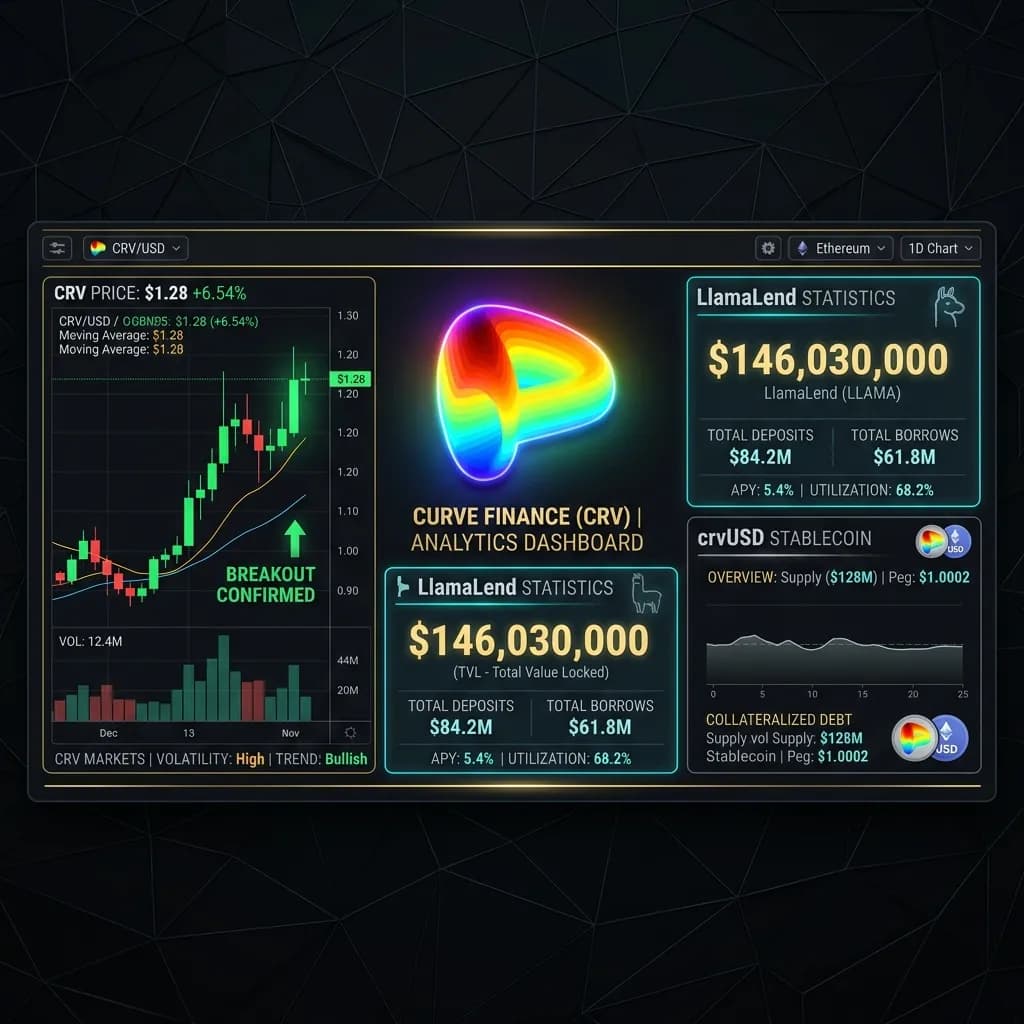
Photo Dispatch: CRV Trading and Curve Price Updates research dashboard showing LlamaLend V2 TVL stats, crvUSD borrowing flywheel, and technical breakout chartsSource: Yaga Newsroom Field Wire
“CRV broke out of its multi-month consolidation range as Curve Finance quietly rebuilt its infrastructure. We audit LlamaLend V2, crvUSD borrowing flywheels, 55% locked CRV supply, and protocol revenue realities.”
CRV trading activity has surged following a breakout from its multi-month $0.20 accumulation range. Fundamental drivers include LlamaLend V2 TVL scaling to $146M+, crvUSD borrowing reaching $37.8M backed by $70.5M collateral, 55% of circulating CRV (~851M tokens) locked as veCRV, and annual emissions declining by 15.9% toward ~97M CRV/yr. Key technical levels to watch for CRV price updates include $0.237–$0.245 support and resistance targets at $0.266, $0.33, and $0.40.
Table of Contents
CRV Trading & Curve Price Updates: Curve Finance (CRV) has broken out of a multi-month accumulation range as market participation accelerates. Behind the price rally lies a structural transition: Curve has evolved from a specialized stablecoin DEX into an integrated DeFi machine powering isolated lending (LlamaLend V2), soft liquidations (crvUSD), and a tightening supply structure where 55% of circulating CRV (~851M tokens) remains locked. However, protocol fees (~$1.43M monthly) still lag token emissions, making risk management essential when trading key price levels between $0.237 support and $0.33–$0.40 resistance targets.
Locked up to 4 yrs as veCRV
Expanded across LlamaLend V2
Backed by $70.5M collateral
Dropping to ~97M CRV/yr
The Curve Most Traders Remember Doesn't Exist Anymore
For years, CRV gave altcoin traders very little reason to pay attention. Following the multi-year crypto drawdown, founder leverage liquidations, and high-profile protocol exploits, CRV was grouped into the category of “legacy DeFi tokens” left behind by modern capital flows.
Ask the average crypto trader what Curve Finance does today, and you will almost certainly hear a single answer: “It's a stablecoin DEX for low-slippage swaps.” While that remains true, it is no longer the complete picture.
Legacy Curve Architecture
In earlier cycles, Curve functioned as a single-purpose liquidity machine, dependent entirely on high DEX swap volumes to maintain TVL and justify token emissions.
Emerging Curve Ecosystem Flywheel
Curve has transformed into an interconnected infrastructure stack spanning DEX liquidity, isolated lending, overcollateralized stablecoins, savings products, and automated liquidation protection.
LlamaLend V2: Turning DEX Liquidity into Productive Loan Collateral
The single most critical fundamental upgrade behind the recent CRV momentum is the expansion of LlamaLend V2. Curve already possessed a lending prototype, but V2 fundamentally changes how collateral and debt operate across DeFi.
Core Architectural Enhancements in LlamaLend V2
Each lending pair operates with standalone collateral, borrowed assets, pricing oracles, interest rate curves, and custom debt limits, protecting the broader protocol from localized bad debt.
Traders no longer leave LP tokens idle. Yield-bearing Curve LP positions can be deposited directly as collateral to borrow stablecoins or blue-chip assets.
After initial deployment on Optimism, LlamaLend V2 expanded to Ethereum mainnet, introducing specialized markets around yield-bearing assets such as sDOLA, sfrxUSD, and syrupUSDC.
Reporting shows LlamaLend TVL scaling steadily from $125M → $132M → $146M+, with total collateral deposited reaching ~$131M and borrowed assets climbing to ~$86M.
crvUSD & The LLAMMA Soft-Liquidation Mechanism
Traditional crypto lending platforms (like Aave or Compound) rely on binary hard liquidations: if collateral drops below a precise health threshold, third-party searchers liquidate the entire position, slapping borrowers with heavy penalty fees and market slippage.
Curve's native dollar, crvUSD, uses an algorithmic soft-liquidation engine called LLAMMA (Lending-Liquidating AMM Algorithm). LLAMMA continuously converts collateral into crvUSD as prices fall, and back into collateral as prices recover, avoiding sudden liquidation cascades.
crvUSD Operating Statistics
Recent Expansion Trends
During recent monthly cycles, crvUSD borrowing expanded rapidly from $28.5M → $36.7M+, while total collateral backing positions grew from $49.4M → $70.5M.
Curve does not need crvUSD to surpass USDT or USDC in market cap. Its goal is internal capital efficiency: creating a closed-loop economy where borrowing fees, DEX swaps, and LP yields reinforce each other.
The Supply Equation: 55% of Circulating CRV is Locked
While traders often focus exclusively on price charts, the underlying supply dynamics of CRV have tightened significantly compared to previous cycle years.
Circulating vs Locked Supply Breakdown
Out of approximately 1.55 billion circulating CRV tokens, roughly 851 million CRV are locked in vote-escrowed veCRV contracts.
Annual Emission Decay (-15.9%)
CRV token emissions decrease by 15.9% annually. The current annual emission rate of approximately 115.5 million CRV is approaching its next scheduled reduction toward ~97 million CRV per year.
The Convex (CVX) Multiplier: Why CRV Doesn't Trade Alone
One of the most common mistakes made by retail traders analyzing CRV is evaluating it in isolation without factoring in Convex Finance (CVX).
Curve governance determines which liquidity pools receive CRV emissions. Because liquidity follows yields, controlling veCRV voting power holds immense economic value for protocols competing for deep liquidity. Convex built an entire aggregation layer to lock CRV (as cvxCRV) and optimize voting power on behalf of CVX holders.
Convex Controls ~50% of Total Curve Voting Power
Because Convex controls roughly half of all veCRV voting influence, demand for Curve liquidity incentives directly impacts CVX lockups and vote-bribe marketplace revenues. When analyzing major CRV setups, traders should always monitor CVX accumulation as a leading momentum indicator.
CRV Price Updates & Key Breakout Technical Levels
After spending months consolidated inside a low-$0.20 range, CRV initiated a multi-week breakout on surging derivatives volume. Here is the technical roadmap for CRV price updates:
Reclaiming $0.330 on the daily timeframe would signal a major structural shift out of the multi-year downtrend.
A daily close below $0.200 invalidates the immediate bullish breakout thesis and suggests returning to range consolidation.
The Revenue Disconnect: Protocol Financials vs Price Speculation
To maintain a disciplined, non-emotional trading framework, we must audit the numbers that keep CRV bull cases grounded.
Curve DEX TVL sits around $1.4B, down from average protocol TVL of ~$3.05B during 2025. Total liquidity scale remains below previous cycle peaks.
DefiLlama metrics show ~$1.43M in 30-day fees against ~$404K protocol revenue, while CRV token incentives ran ~$1.98M over the same window.
Despite impressive LlamaLend V2 TVL growth, recent reporting confirms V2 has not yet generated substantial admin-fee revenue for veCRV holders.
5 Core Metrics to Track for CRV Trading Confirmation
| Metric Target | Current Benchmark | Bullish Continuation Criteria | Why It Matters |
|---|---|---|---|
| Curve DEX TVL | ~$1.40 Billion | Sustained rise above $2.0B | Validates capital returning to core DEX pools. |
| LlamaLend TVL | ~$146 Million | Breakout toward $250M+ | Confirms lending diversification success. |
| crvUSD Borrowing | ~$37.8 Million | Expansion above $50M+ | Powers internal interest yield & fee loop. |
| Locked CRV Supply | ~851M (55% locked) | Maintenance above 50%+ | Ensures float squeeze remains active. |
| LlamaLend V2 Fees | Minimal Admin Revenue | Positive Cash Flow Spikes | Proves real protocol monetization. |
How YagaCalls Trades CRV & Altcoin Breakouts
We don't buy blindly into green candles or Twitter hype. At YagaCalls, every swing trade setup undergoes strict 4-tier verification before being issued to our telegram members:
Fundamental Audit
Analyze TVL, tokenomics & developer catalysts.
Liquidity Timing
Identify high-volume regional session windows.
Invalidation Anchor
Place strict stop loss below key support levels.
Scaled Profit Exit
Take TP1 profits and lock stops to breakeven.
Related Strategic Research & Guides
Ready to Trade with Professional Guidance?
Get narrative-driven setups, strict risk invalidation levels, and precise entry targets sent directly to your private Telegram thread.
Would you hold Bitcoin through an -85% drawdown without panic selling?
Hindsight makes crypto compounding look simple. Run any historical capital allocation through our Crypto Historical Return Calculator to test true peak-to-trough cycle drawdowns across 150+ assets.
Frequently Asked Questions
Recommended Topic Cluster Reading
Narrative Trading in Crypto: How Market Stories Move Altcoins
Technical indicators alone fail in volatile altcoin cycles. Master the art of narrative velocity, sector rotation, and tracking catalysts like AI, RWA, and DePIN.

SUI Rally Case Study: How Narrative and Timing Shaped the Setup
An in-depth case study of the SUI breakout. Learn how we merged ecosystem capital flow, timezone liquidity shifts, and technical invalidation structures into a 47% spot rally.
Educational & Informational Content Only
All cryptocurrency signal recommendations, narrative analysis studies, timezone liquidity reports, stop-loss calculations, and market structure commentary published by Yaga Calls are intended strictly for educational and informational purposes only. This content does not under any circumstances constitute financial, investment, legal, or tax advice.
Cryptocurrency asset markets are highly speculative, unregulated in many jurisdictions, and carry an extreme risk of financial loss, high volatility, and exchange-side liquidation. Past performance case studies (such as our historical SUI breakout setups) do not under any circumstances guarantee or predict future market results. Always implement proper position-sizing limits, never average down on a failing position, and never trade with capital you cannot afford to lose.